The Scandinavian method of curing raw salmon with salt, sugar and herbs gets an eye-catching twist with the addition of beetroot here – apparently a Finnish variation. You can use other fish too – trout, for example, or mackerel (which will take only about 3 hours to pickle.) The accompanying sauce is a particular family favourite – Babú has been known to eat it by the ladleful – and is the only purpose for which I ever use the darker brown French mustard.
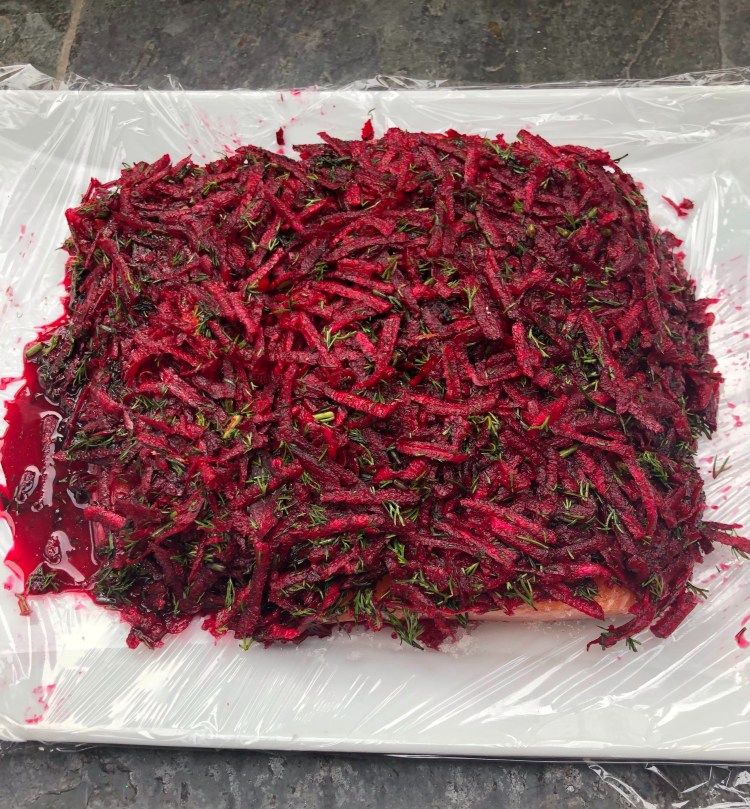
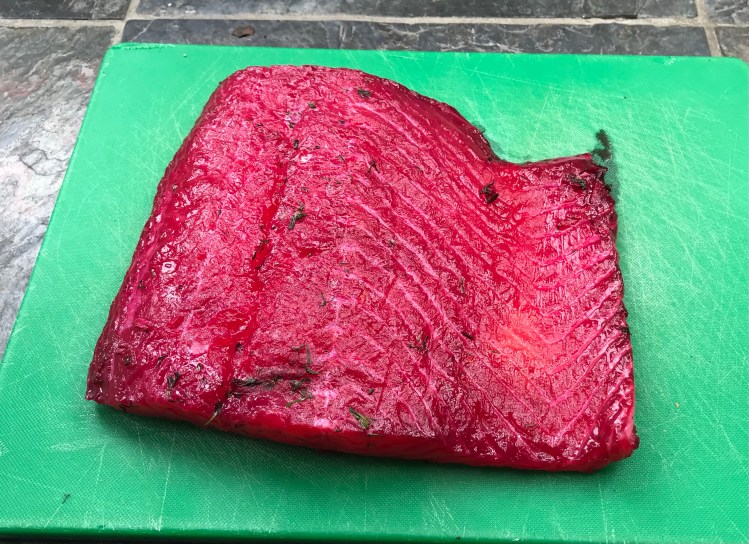
Before and after 36 hours in the fridge
Serves 6
Ingredients
200g beetroots, uncooked, peeled and grated 20g fresh dill, finely chopped 2 tbsp sugar 2 tbsp vodka 600g salmon fillet, scaled and de-boned 1 orange, zest finely grated 2 tbsp sea salt Radishes to serve (optional)
Method
Place the salmon skin side down on a piece of clingfilm. Mix the salt and sugar together, and rub evenly over both sides of the fish.
In a small bowl mix the beet, orange, dill and vodka, then press this all over the salmon. Wrap up the clingfilm, then wrap in foil, put on a plate and place another plate on top with a weight on it. Chill for 36 hours.
After chilling, unwrap the fish and remove the coating (scrape or rinse off). Slice thinly down to the skin and arrange the slices, slightly overlapping on a serving plate or on individual plates. Garnish with dill sprigs and, if you like, sliced red radish. Serve with the sauce below.
Mustard & Dill Mayonnaise
Ingredients
1 large egg yolk 2 tbsp French mustard 1 tbsp white sugar 150ml groundnut or sunflower oil 1 tbsp white wine vinegar 1 tbsp finely chopped dill Salt and pepper (ideally white)
Method
Whisk the egg yolk with the mustard and sugar in a medium-sized bowl, drip in the oil drop by drop whisking all the time until the mixture has emulsified, then add the vinegar and dill and season with salt and pepper.
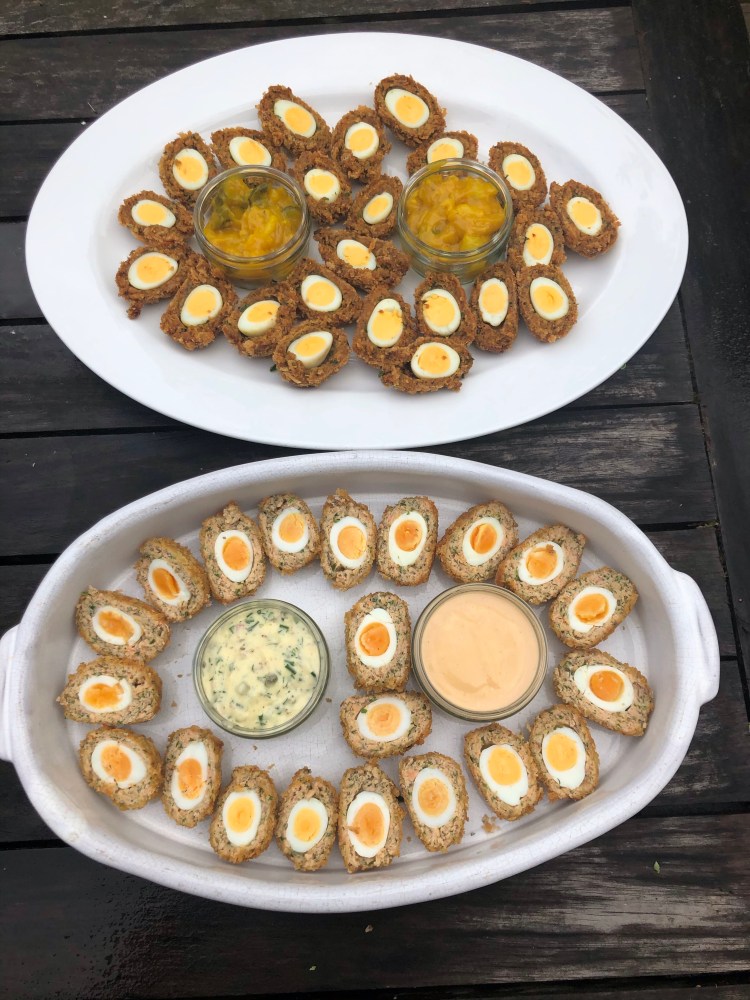
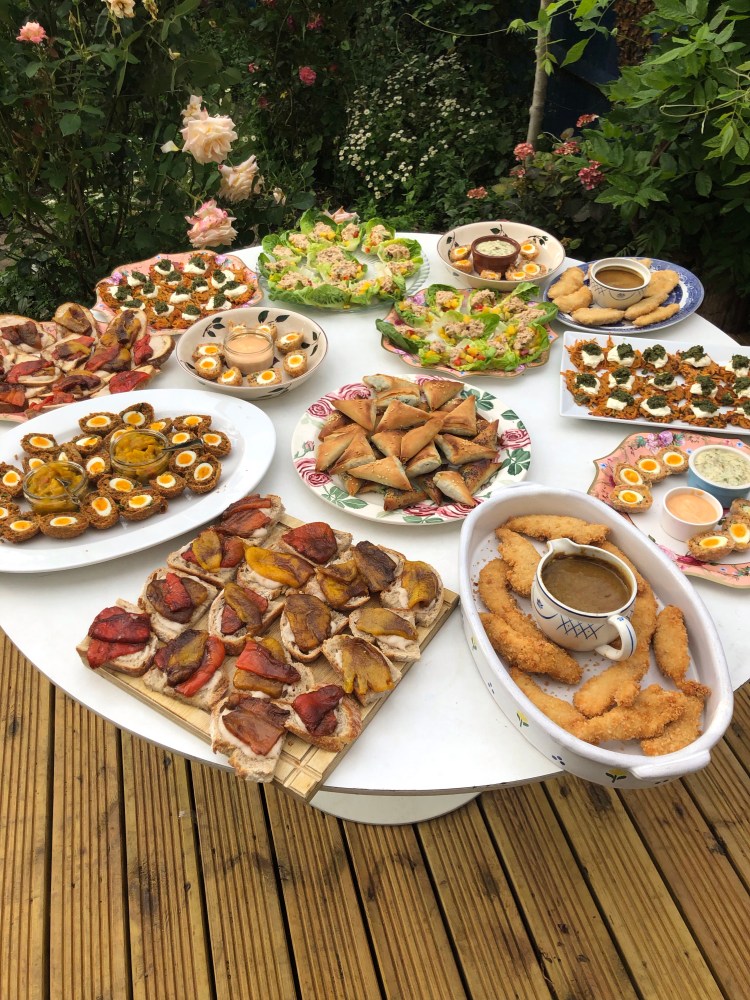
There has been much experimentation chez Collier with scotch eggs in the past couple of years. A BBC Food recipe was my original source for smoked salmon scotch eggs, while a recent recipe by Thomasina Miers prompted me to come up with a vegetarian version of chorizo scotch eggs – I order the meat-free sausage mix and vegan chorizo from Amazon. Both can be made with normal hens’ eggs or with dinkier quails’ eggs, which take a while but make very pretty canapés. Simply replace the large eggs in the recipes below with a dozen (or more) quails’ eggs. Serve with a sharp mayonnaise, marie rose sauce, tartare sauce (recipes all here) or, in the case of the chorizo ones, piccalilli.
Top: vegetarian chorizo quails’ egg scotch eggs with piccalilli Bottom: smoked salmon quails’ egg scotch eggs with tartare sauce and marie rose sauce
Smoked salmon scotch eggs
Serves 4
Ingredients
5 large eggs, at room temperature 2 salmon fillets, boneless and skinless, about 240g 200g good quality smoked salmon 1 lemon, zested, then cut into wedges to serve ½ small pack dill, chopped ½ small pack parsley, chopped 1 tbsp capers, chopped 50g plain flour good pinch cayenne pepper 100g panko breadcrumbs vegetable oil for frying
Method
1. Put 4 of the eggs in a large pan of cold water and bring to a boil. Turn down the heat, simmer for 5½ minutes, then remove and transfer to a bowl of iced water. Once cool, gently tap all over on a work surface and peel carefully, so as to keep the eggs intact. If you’re using quails’ eggs, put straight into boiling water and simmer for 1 ½ minutes.
2 Blitz the salmon, smoked salmon, lemon zest and some seasoning together in a food processor to form a paste, then stir through the herbs and capers. Divide the mixture into four balls. Pat the eggs dry, then flatten a ball in the palm of your hand and tease it around one of the eggs until completely covered. Repeat with the remaining eggs. Set aside.
3. Set up your assembly line: put the flour in one bowl, stir in the cayenne pepper and season. Crack the remaining egg into another and whisk, then put the breadcrumbs in the final bowl. One by one, dip the Scotch eggs into the flour, egg and then the breadcrumbs. Set aside on a plate or tray.
4. Fill a heavy-bottomed pan two-thirds with oil and heat to 180C or until a piece of bread browns in 20 seconds. Working in batches, fry the Scotch eggs for 5 mins until deep golden, drain on kitchen paper and sprinkle with flaky sea salt and a little more cayenne. Serve with a sauce of your choice and lemon wedges for squeezing over.
50g plain flour, seasoned with salt, pepper and any spicing you fancy 2 eggs, beaten 100g panko or fine breadcrumbs Vegetable oil, for deep-frying
Lemon wedges and sauces to serve
1. Hydrate your meat-free sausage mix as directed on the packet. Remove the chorizo from its skin and blitz in a food processor to crumble it.
2. Put the eggs in a large pan of cold water and bring to a boil. Turn down the heat, simmer for 5 ½ minutes, then remove and transfer to a bowl of iced water. Once cool, gently tap all over on a work surface and peel carefully, so as to keep the eggs intact. If you’re using quails’ eggs, put straight into boiling water and simmer for 1 ½ minutes.
3. Mix the sausage ‘meats’, herbs and parmesan in a bowl, scrunching it all together until sticky. Divide into six even-sized balls, then wet your hands and flatten one ball in your palms, making it as thin as you can without it falling apart. Gently shape it evenly around one peeled egg, moulding it until the egg is sealed all over. Repeat with the rest of the eggs, then set aside.
4. Set up your assembly line: seasoned flour, beaten egg and breadcrumbs. Pour enough oil into a deep pan to come 5-6cm up the sides and heat to 160C-170C. Roll each egg in the seasoned flour, followed by the egg and then the breadcrumbs.
5. Once the oil is hot, fry the eggs three at a time for three to four minutes, or until the breadcrumbs are golden. Scoop out and drain on kitchen paper. Serve with the lemon wedges and a green salad, with piccalilli or tartare too.
Rules, especially arbitrary, self-imposed ones, are made to be broken. I am flouting a founding principle of the blog today in choosing to share this recipe, because we’ve only eaten it once, two months ago, and it therefore does not qualify – by any stretch of the imagination – as an established family favourite. I’m quite sure it will be up there before long, though, and encourage you to get making it because it really is ‘a wow of a pie’, as its creator Sami Tamimi (in his wonderful book Falastin) describes it. The list of ingredients is long and the method is protracted but I promise it’s worth the effort.
I forgot the chilli flakes here!
Serves 6
Ingredients
750g chicken thighs, skinless and boneless 4 garlic cloves, crushed 2cm piece of ginger, peeled and finely grated 2 tsp ground cumin 2 tsp ground coriander ¾ tsp smoked paprika ½ tsp ground turmeric ¾ ground cinnamon ⅛ tsp ground cloves 90ml olive oil, plus extra for greasing 2 tbsp cider vinegar 2 baking potatoes (450g), unpeeled and cut into ½cm-thick rounds 45g unsalted butter 1 onion, thinly sliced (150g) 200ml chicken stock 5g parsley leaves, roughly chopped 5g coriander leaves, roughly chopped 8 sheets (30 x 38cm) of good-quality filo pastry (170g) 1 tsp nigella seeds ¾ tsp Aleppo chilli flakes or ⅟₃ tsp regular chilli flakes Salt and black pepper
The recipe in Falastin specifies a 23cm springform cake tin but I suspect that any oven-proof dish – and not necessarily a round one – would be fine.
Method
Put the chicken into a large bowl with the garlic, ginger, ground spices, 1 tbsp of oil, the vinegar, 1 tsp salt and a generous grind of pepper. Mix to combine, then leave to marinate for at least half an hour, or overnight in the fridge.
Preheat the oven to 180 fan.
Mix the potatoes with 1½ tbsp oil, ¾ tsp salt and a good grind of pepper. Transfer to a parchment-lined baking tray and spread out so that they don’t overlap. Bake for 20 minutes, then increase the oven temperature to 220 fan. Remove the tray from the oven, flip over each potato slice, then return to the oven for another 10 minutes, or until golden. Remove from the oven and set aside. Reduce the oven temperature to 180 fan again, or turn it off for now and preheat again later, before you bake the pie.
Put 15g butter and 1½ tbsp oil into a large sauté pan and place on a medium-high heat Once hot, add the onion and cook for 5 minutes, stirring occasionally, until softened. Add the chicken and cook for about 10 minutes, until lightly brown, then add the stock, ¼ tsp salt and a good grind of pepper. Bring to the boil, then lower the heat to medium. Simmer gently for 25 minutes, or until the chicken is just cooked through. Increase the heat to medium-high and continue to cook for about 8 minutes, or until the liquid has thickened and reduced to about 4 tbsp. Remove from the heat and leave to cool for about 10 minutes, then use two forks to shred the chicken into large chunks. Stir in the herbs and set aside.
To make the tahini sauce, put the tahini, yoghurt, garlic, lemon juice, ⅛ tsp salt and 2 tbsp water into a bowl. Whisk together until smooth, then set aside.
Melt the remaining 30g butter and combine with the remaining 2 tbsp oil. Line the base of a 23cm springform cake tin with baking parchment and lightly grease the sides with some of the butter mixture. Lay a sheet of filo out on a clean work surface and brush with the butter. Transfer this to the tin so that the base is covered and the filo rises up and over the tin’s sides. Repeat with the next sheet of filo, brushing it first with butter, then arranging it in the tin, rotating it slightly so that the excess hangs at a different angle. Continue in this fashion, brushing each piece generously as you go, until you have used up 6 pieces of filo in total and tha base and sides are all covered.
Next, add the potato slices, overlapping slightly, so that the base of the pie is completely covered. Top with the chicken mixture and gently push down to even out. Lastly, spoon over the tahini sauce, spreading it gently to coat the chicken layer. Brush a piece of filo with butter and fold it in half horizontally, like a book. Place this over the tahini layer, tucking in the filo around the filling. Brush the top with the butter mixture, then repeat with the last piece of filo, angling it to cover any exposed areas. Now fold over the overhang, crinkling up the filo to create a nice ‘crumpled’ effect on the top. Brush the top with the remaining butter, sprinkle with the nigella seeds, place on a tray and bake at 180 fan for 60 minutes, or until deeply golden.
Leave to cool for about 15 minutes before removing from the tin. Sprinkle with the chilli flakes and serve with a crisp green salad.
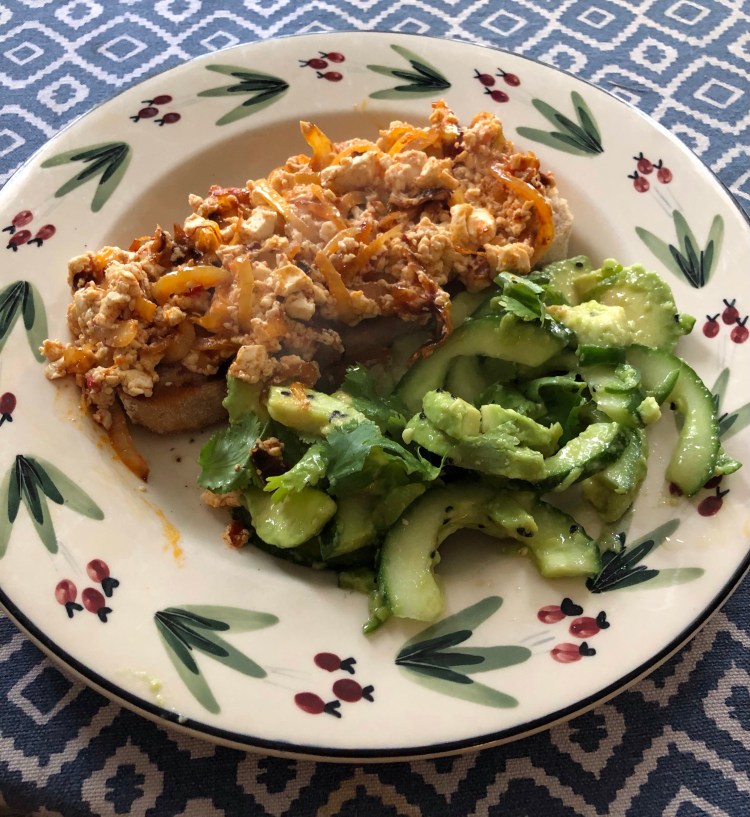
Even when we’re not conducting a flirtation with veganism, I like to wheel this out for a weekend brunch. A delicious alternative to eggs, it might be considered a ‘Gen Z rántotta’, because it recalls the paprika-spiced scrambled egg-and-onion dish Babú would cook on those rare occasions when family supper was left up to him. Served on thick slices of grilled sourdough bread with a green salad alongside, it becomes a complete and balanced vegan meal.
Serves 6
Ingredients
2 tbsp olive oil 2 onions, finely sliced 1½ tbsp rose harissa (I use Belazu, but you could make your own apricot harissa) 700g silken tofu, drained 6 slices of sourdough, grilled or toasted salt
Avocado & cucumber salad
½ cucumber, sliced in half lengthways, deseeded and thinly sliced on an angle 2 green chillies, deseeded and thinly sliced 3 ripe avocados, thinly sliced 20g picked coriander leaves 1 tbsp olive oil 2 tbsp lime juice 1 tsp nigella seeds
Method
Heat the oil in a large frying pan on a medium heat. Add the onions and fry for 9-10 minutes, stirring frequently until caramelised and soft.
While the onions are frying, mix all the ingredients for the salad with ⅟₃ teaspoon of salt and set aside.
Add the harissa to the onions and continue to stir for 1 minute, then add the tofu and ¾ teaspoon of salt. Use a potato masher to break up the tofu so it looks like scrambled egg, and continue to heat for 2 minutes so it’s hot. Serve the scrambled tofu on the grilled sourdough with the salad alongside.
These make terrific vegetarian canapés – or you could make them bigger and serve two or three as a starter. The recipe comes from a Times feature on ‘speedy canapés’ back in 2017 and has been wheeled out for two or three Collier parties since then, so definitely qualifies for inclusion here. The rösti and pesto mixtures can be made up well in advance: all you need to do at the end is the frying.
To make the pesto, place all the ingredients into a food processor or chop finely by hand to combine well.
Place the sweet potato in a small pan of cold, salted water and boil for 5 minutes. Drain, cool and coarsely grate it into a bowl. Add the other rösti ingredients except the oil, and mix well.
Heat a large frying pan with a little oil. Shape a small rösti patty and fry for 1-2 min on each side to check whether more seasoning is needed. Fry the röstis in two batches. Pack each one together densely so it doesn’t break up, and flatten them as they cook, making sure that there is always a small amount of oil in the frying pan. Keep the heat medium-low so that the röstis do not burn. Allow to cool before topping with a small teaspoon of crème fraîche and some pesto on each rösti.
Google this dish and you’ll get a competing array of recipes claiming to be ‘the best’, ‘original’ or ‘the real sailors’ version’. Really, it’s up to you whether you use onions or shallots, add a leek or some lemon zest and finish with butter, cream or crème fraîche. The essential elements are a large pile of well-cleaned mussels and sturdy hunks of bread to mop up the juices.
Serves 4
Ingredients
2 kg mussels 2 shallots, finely chopped 2 garlic cloves, finely chopped 15g butter 200ml dry white wine or cider 120 ml double cream or crème fraîcheor more butter 4 tbsp fresh parsley salt and pepper crusty bread, to serve
Method
Wash the mussels under plenty of cold, running water. Discard any open ones that won’t close when lightly squeezed. Pull out the tough, fibrous beards protruding from between the tightly closed shells and then knock off any barnacles with a large knife. Give the mussels another quick rinse to remove any little pieces of shell.
Soften the garlic and shallots in the butter, in a large pan big enough to take all the mussels – it should only be half full. Add the mussels and wine or cider, turn up the heat, then cover and steam them open in their own juices for 3-4 minutes. Give the pan a good shake every now and then. Discard any that steadfastly refuse to open.
Scoop the mussels out into a warm tureen or bowl and keep warm. Add the cream and half the chopped parsley to the liquid left in the pan and boil briefly. If you’re using butter rather than cream at this stage, whisk it in. Taste and adjust seasoning. Pour the liquid over the mussels, sprinkle with the remaining parsley and serve with lots of crusty bread.
This is a pudding redolent of summer and incredibly easy to make. You can buy your meringues ready-made or whip up your own with any spare egg whites hanging around (from making hollandaise sauce or mayonnaise or custard, say). There are all sorts of meringue recipes out there and I’m not claiming my version below is ‘the one’: it’s simply what I’ve just found among the scrawled scraps of paper that constitute my recipe collection. Equally, don’t feel wedded to strawberries if you prefer raspberries; use some Chambord or Crème de cassis instead of port, or no booze at all; add a dash of vanilla to your whipped cream if you like and wheel out a raspberry coulis too if you feel like showing off.
Serves 4
Ingredients
400g strawberries 1-2 tbsp port 8 meringues 300ml double or whipping cream
Whisk the egg whites until they are beginning to form soft peaks; add the vinegar and continue to whisk. Add the sugar a spoonful at a time and continue whisking until the mixture is stiff and glossy.
Line a baking sheet with non-stick parchment paper. Pipe or spoon the meringue mixture in large dollops, evenly spaced. Bake for 2 hours. Remove and allow to cool. They will keep for ages in an airtight container.
To make the actual Eton mess
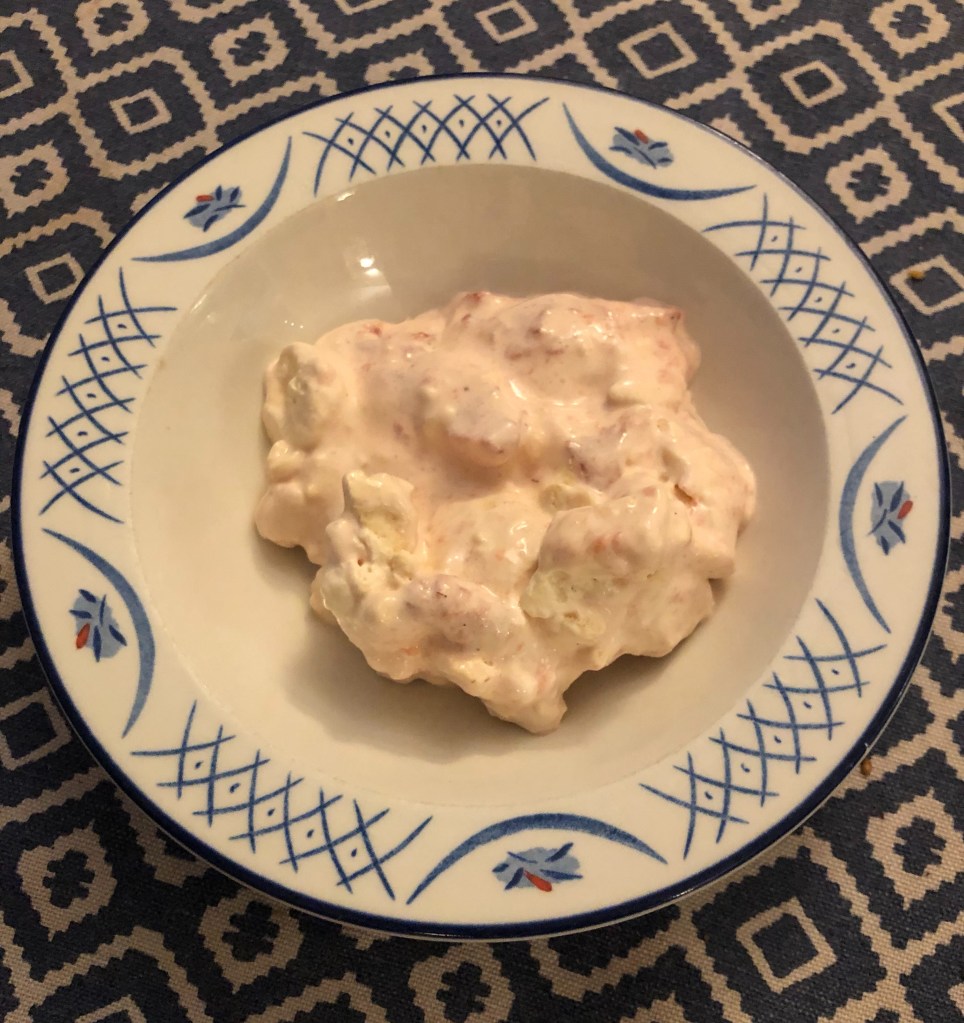
Hull and halve the strawberries. Mash with a fork a bit so that each half is slightly crushed and some juice accumulates around them. Stir in the port (or other booze) if using. Softly whip the cream and keep chilled. This much can be done well in advance; it’s advisable to delay the actual assembly of the components until the hour before you eat, so that the meringues don’t just dissolve into the mixture. Break up the meringues into bite-sized chunks and fold into the strawberry mush along with the whipped cream. Try not to mix it all up too vigorously – the three elements should ideally be distinguishable, although I have clearly failed to achieve that in the pictures above. Serve in one large bowl or in individual dishes.
Today’s recipe, a memorable component of our summer picnic lunches in Hungary, is introduced by a guest contribution from your father, king of the holiday morning routine. He has thrown in as many original Hungarian words as he can muster – presumably in a bid to convince the Consulate that he knows enough of the language to qualify for citizenship:
“Mornings in Hungary always began with a trip to the shop, in Budapest to the supermarket Kaiser – whose arrival on the Rózsadomb in the late 90s symbolised and emphasised the rapid changes in economy and society – and in Zebegény to The Shop. I never knew its name and it was distinguished from the other shops only by not being The Paddling Pool Shop.
Zebegény is where the memories lie. Out of the car, into the shop, and it was always breakfast food first. Kifli, the crisp Magyar croissants selected from the big plastic bin through a porthole in the side, ever an opportunity for a quick counting lesson for the young. And the 0.9% milk in a bag, often at risk of already souring in the searing heat of the early post-communist days when Sam and Louis were babies. The pastries: csoki, meggy, barack, almás, mákos – pre-departure individual orders would have been issued. And drinks: the uniquely Hungarian taste of alma, őszibarack, or szőlő, in big cartons, and chocolate and strawberry milk. Sometimes we needed to re-up on bear honey in the squeezy bottle.
Then the lunch food: bezhlums, of course, one per person, [editor’s note: the correct name for these is zsömle] and bonfire cheese, eggs rattling in a small bag – no cartons here – and then szalámi and pink meat, párizsi, sliced with unsmiling precision by the crone behind the counter – unsmiling, that is, until one of the babies caught her eye, whereupon she would burst into a stream of unearthly cooing and heavily accented witch-language, only the word ‘baba’ recognisable amid the gibberish. I’d look proud, the baby would look scared.
Finally, day drinks to accompany the meat and bread and cheese: big bottles of szénsavas víz, and fizzy pop, and, of course, sör – sok sör. And once or twice a week we’d buy bigger cuts of meat, for a traditional goulash, perhaps, or some other homely Magyar dish, or lemon chicken; although, truth be told, with the exception of the ritual bográcsgulyás – always a magical night, making and stoking the fire and then gathering in the gloaming to sit on logs to eat around the cauldron – we looked forward to eating out at the Kenderes or in Nagymaros or, occasionally, at the Fekete Sas, as much as we did to cooking and eating at home in Zebegény.
The shopping bags, the big, industrial strength woven nylon bags, weighing a ton, would now be overflowing with the spoils of the day to be consumed, and I would stagger with them, sometimes with a child on shoulders, to get them into the back of the car and return to base to begin eating it all.
The ritual concluded as we arrived home, through the green metal gates, down the little hill to the parking place, and then unloading, the distinctive scent of Hungarian coffee in the air, the table laid by those who had stayed at home, and the sun rising higher over the Danube as we sat outside in the delicious heat to break bread together and discuss the plan for the day – a walk to the kis szikla, some kayaking on the river, perhaps even some rat-hunting in the undergrowth.”
Put the eggs in a pan of cold water. Cover the pan, bring to the boil and, once boiling, set your timer for 8 minutes. When the buzzer goes, drain the eggs, crack each one slightly to arrest the cooking process and then plunge into cold water for 15 minutes. Meanwhile, combine all the other ingredients in a bowl.
Peel the cooled eggs and cut each one in half. Gently scoop out the yolks and mash into the mayonnaise mixture. Arrange the empty egg halves on a serving plate and re-fill each one generously with the herb mixture.
Variations upon a stew of onions, peppers and tomatoes are found across a range of cuisines. The name we use for our version, Piperade, is of Basque origin, although in a departure from the traditional template I would usually choose red and yellow peppers over green. In Italy, the dish is called Peperonata, while in North Africa and the Middle East it becomes Shakshuka. If we were making it in Hungary we would call it Lecsó, using pointed green peppers and fresh tomatoes (in a ratio of 2:1 by weight) and lots of paprika. It can be eaten at any time of day: with baked eggs for breakfast, for example, or to accompany baked potatoes and sausages for lunch or supper.
Serves 4
Ingredients
1 onion, halved and sliced 2 tbsp olive oil 2 yellow peppers, quartered and cut into fat strips 1 tin chopped tomatoes 1 bay leaf Dried or fresh herbs of your choice and/or paprika / Aleppo chilli / chilli flakes Salt & pepper
Method
In a frying pan for which you have a lid, heat the olive oil over a medium heat. Add the onion, lower the heat and cook to soften for eight minutes. Add the garlic and cook for a further minute. Now add the peppers, stir and cook gently for another 5 minutes. Add the chopped tomatoes, bay leaf, dried herbs / paprika / chilli flakes, salt and pepper. Bring to a simmer, cover the pan and cook for 20 minutes. The timings here are quite approximate and the seasoning options are really up to you. If you have fresh herbs, add these towards the end. Serve warm or at room temperature.
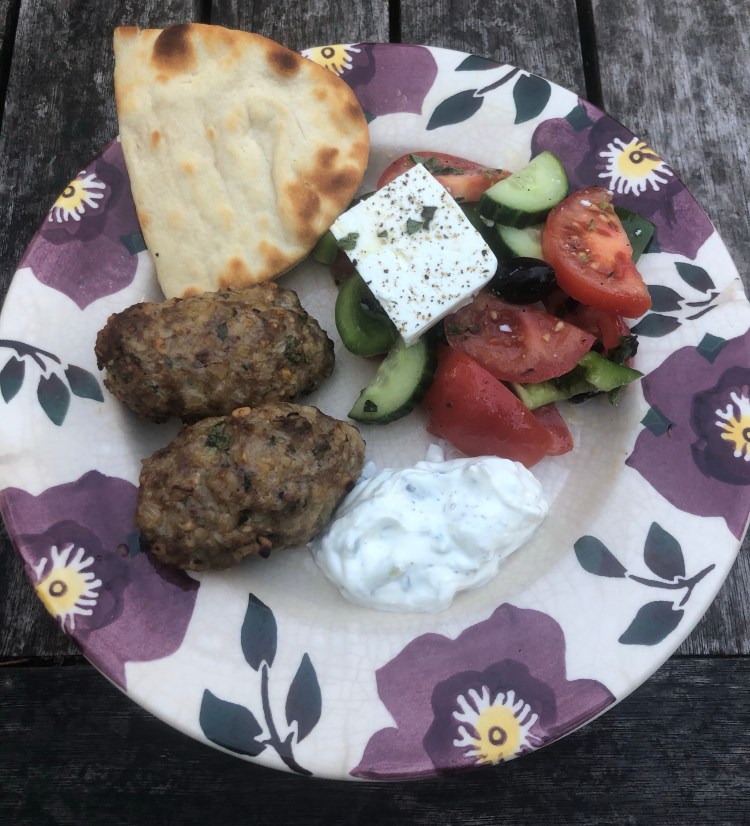
Lamb koftas or kebabs invariably get an outing during barbecue season. They go well with a range of sauces and sides: houmous, aubergine dip, tsatsiki, tabouleh and Greek salad. We’ll often have a spanakopita and skewered vegetables as well, to keep the vegetarians happy. Our go-to lamb kofta recipe – the first one below – comes from Rena Salaman’s trusty book, The Cooking of Greece and Turkey (1987), which is also the source of Greek Walnut Cake. My more recent efforts in repertoire expansion have drawn me to some Ottolenghi recipes, two of which, from Simple (2018) went down a treat during Lockdown 1 and are reproduced for you here. They’re both designed to be cooked in the kitchen – fried in a pan or baked in the oven respectively – but can easily be adapted for outdoor grilling.
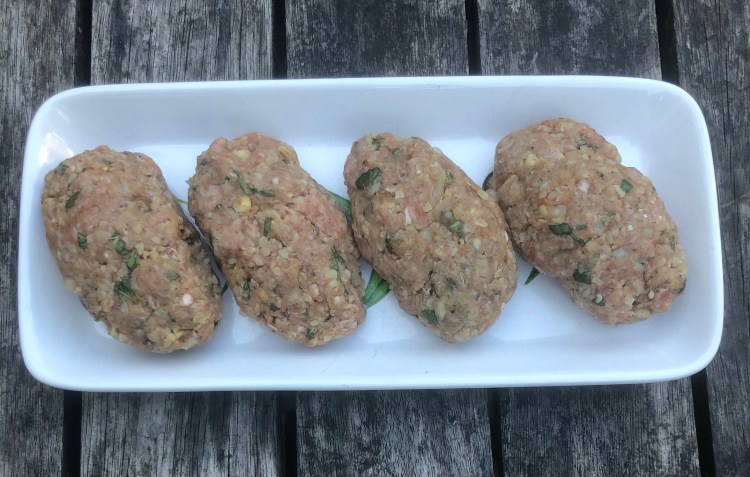
Minced lamb and cracked wheat kebabs
Makes about 12
Ingredients
50g bulgur wheat (cracked wheat) 750g minced lamb 1 large onion, grated coarsely 2 cloves of garlic, crushed 3 tbsp chopped fresh mint 1 tsp paprika ½ tsp cayenne pepper 25g pine kernels, chopped coarsely Salt and black pepper
Method
Rinse the cracked wheat and soak it in hot water for 30 minutes. Strain it well, squeezing the water out by hand. Mix it with the remaining ingredients by hand until properly incorporated. Make elongated flat burgers and grill them about 4 minutes on either side.
Lamb koftas with Greek salad and tsatsiki
Lamb and pistachio patties with sumac yoghurt sauce
Makes about 20
Ingredients
60g pistachio kernels 25g rocket leaves 1 onion, quartered (150g) 1 large garlic clove, peeled 500g lamb mince 3 tbsp olive oil Salt and black pepper
Mix together all the ingredients for the sumac yoghurt sauce and keep in the fridge until needed.
To make the patties, put the pistachios into the small bowl of a food processor. Blitz for a few seconds, to roughly chop, then transfer to a bowl. Add the rocket to the processor, blitz to roughly chop, then add to the bowl of pistachios. Continue with the onion and garlic, to form a smooth paste, and add to the bowl. Add the lamb, 1 tbsp oil, ¾ tsp salt and a good grind of pepper. Mix well to combine, then, with wet hands, shape the mix into about 20 patties. They should each be about 5cm wide, 2cm thick and weigh about 40g. [If you’re planning to barbecue rather than fry them, I advise making fewer, larger patties because it’s quite fiddly to turn so many small ones over an open grill.] If frying, allow about 7 minutes to cook the small patties through; bigger ones will take a bit longer on the barbecue.
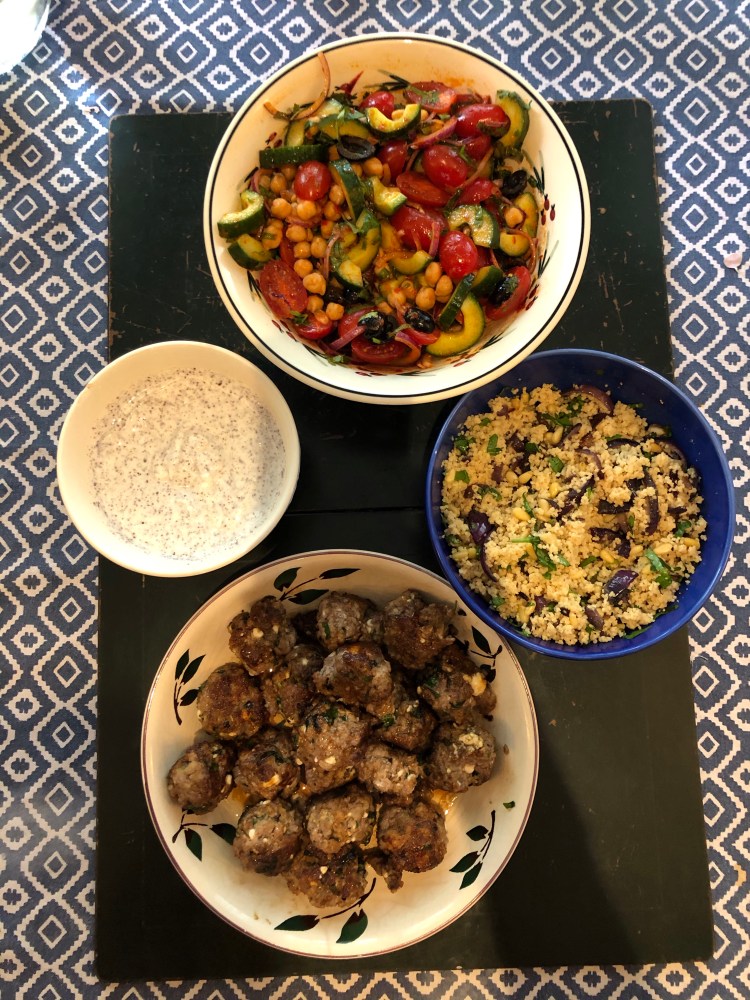
Lamb and feta meatballs
The pomegranate molasses are a great addition, but if you don’t have any, the dish will work fine without.
Serves 6 as a starter or snack
Ingredients
500g minced lamb 2 tbsp picked thyme leaves 2 garlic cloves, peeled and crushed 1 slice white bread, blitzed Salt and black pepper 2 tsp pomegranate molasses, plus 1 tbsp extra to serve (optional)
Heat the oven to 200C. Put all the ingredients apart from the oil and pomegranate molasses in a large bowl, add three-quarters of a teaspoon of salt and plenty of pepper, and mix with your hands to combine. Still using your hands, divide the meatball mix into 18 roughly 35g portions and form each into 4cm-wide balls.
Heat the oil in a large frying pan on a medium-high flame, then fry the meatballs (cook them in batches, if need be), for five to six minutes in total, gently turning them throughout, until golden brown all over. Transfer the meatballs to an oven tray lined with baking paper, drizzle pomegranate molasses over the top, if using, and bake for five minutes, to cook through.
Serve hot, with a final tablespoon of pomegranate molasses spooned on top.
Again, if you want to cook these on the barbecue, shape your meat mixture into fewer, bigger and flatter meatballs. You can brush them with pomegranate molasses while they’re on the barbecue and drizzle over a bit more before serving – or not.
Clockwise from top: tomato, chickpea & harissa salad; couscous, red onions, parsley & pine kernels; lamb & feta meatballs; sumac yoghurt sauce












 Years of Practice