In April 2010, during the Easter break, Babú treated the four of you to a holiday in Hungary. In order to free up the boys to revise for forthcoming exams (and definitely not because he has atavistic views about roles in the kitchen), Babú’s plan was for the girls to cook for everyone on two occasions. I sent you off with recipes and some ingredients for four dishes: wiener schnitzel, rice pudding, lemon chicken and banoffee pie. The recipe for the latter had been long pinned to the fridge at home – a faded clipping from a tabloid newspaper – and comes from Katie Price (yes, really). Fuelled by the delicious ‘banana cake’, Babú then drove you halfway across Europe, handing you over to Dom near Wurtzburg: it was the only way to get you home and back to school after the eruption of an un-spellable Icelandic volcano had grounded all flights.
Serves 6
Ingredients
400g tin of condensed milk 150g digestive biscuits 75g butter 3 large bananas 280ml double cream
Method
Put the can of condensed milk, unopened, in a large pan. Cover with water, bring to the boil and boil for 4 hours, topping up with boiling water from the kettle as needed. Remove and leave to cool.
Put the biscuits in a clean plastic bag or freezer bag and crush with a rolling pin.
Melt the butter in a small pan, add the crushed biscuits and mix until well coated. Press the mixture into the base of a 20cm flan tin, and chill in the fridge for 30 minutes.
Open the can of condensed milk, which will have turned to toffee, and spread over the biscuit layer. Peel and thinly slice the bananas, and arrange in a layer over the toffee.
Whip the cream until thick and spread over the bananas. Chill again before serving.
Rosa, Louis, Zita and Sam at Laci’s country pad, April 2010
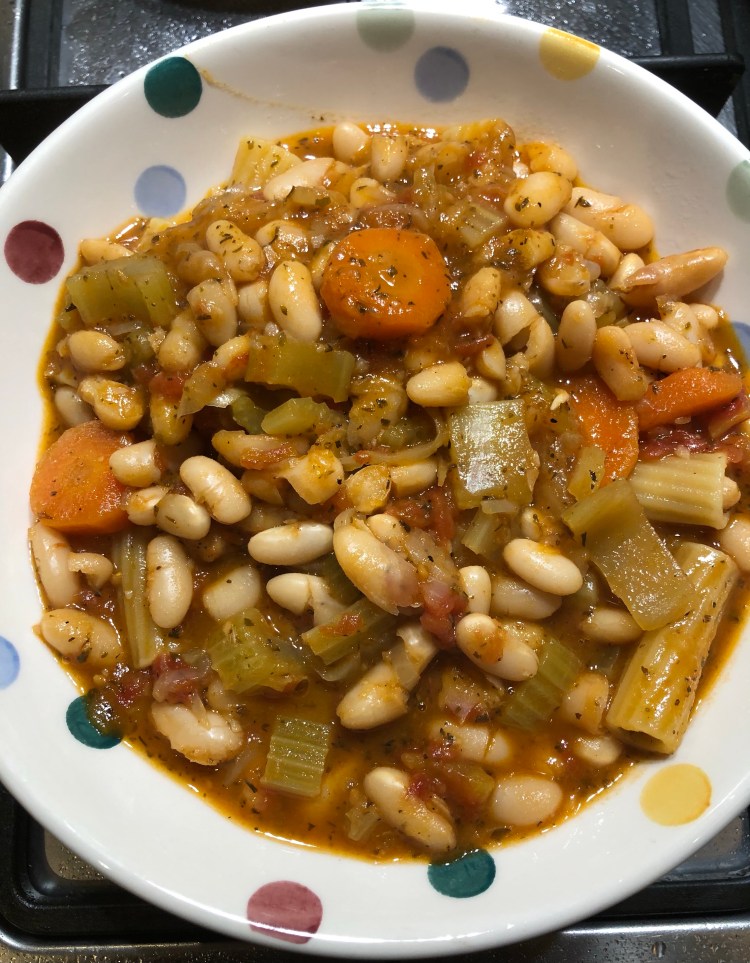
Take the plunge and dip into your stockpile with this cheap, nutritious combination of store-cupboard ingredients. It requires some forethought (soaking the beans overnight) but you could use tinned ones if you forget. Serve with bread or turn into a complete one-pot meal by adding 2 large handfuls of pasta 20 minutes before the end of the cooking time. For non-vegetarians, the addition of chopped chorizo, again towards the end, adds another layer of flavour and texture. One important tip: when you are cooking dried beans, make sure you use an unsalted cooking liquid. The husk of the bean will not soften if cooked in salt.
Serves 6
Ingredients
300g cannellini or haricot beans, picked clean and soaked overnight 1 litre water or stock (chicken or vegetable) 1 large onion, sliced 2 large carrots, sliced 2 fat sticks of celery, sliced 400g can chopped tomatoes 1 tsp tomato purée 1 tbsp each dried oregano and thyme 60ml good olive oil 2 tbsp chopped fresh parsley Salt and black pepper
Method
Wash and drain the beans. Cover them with water, boil vigorously for 10 minutes and drain again, discarding the water. (This step makes the beans digestible.) Put the beans back with the measured water or stock and the rest of the ingredients, apart from the salt and chopped parsley. Cover and cook for 1-1.5 hours, or until the beans are soft but not disintegrating. Add the salt and parsley and simmer for 5 more minutes before serving.
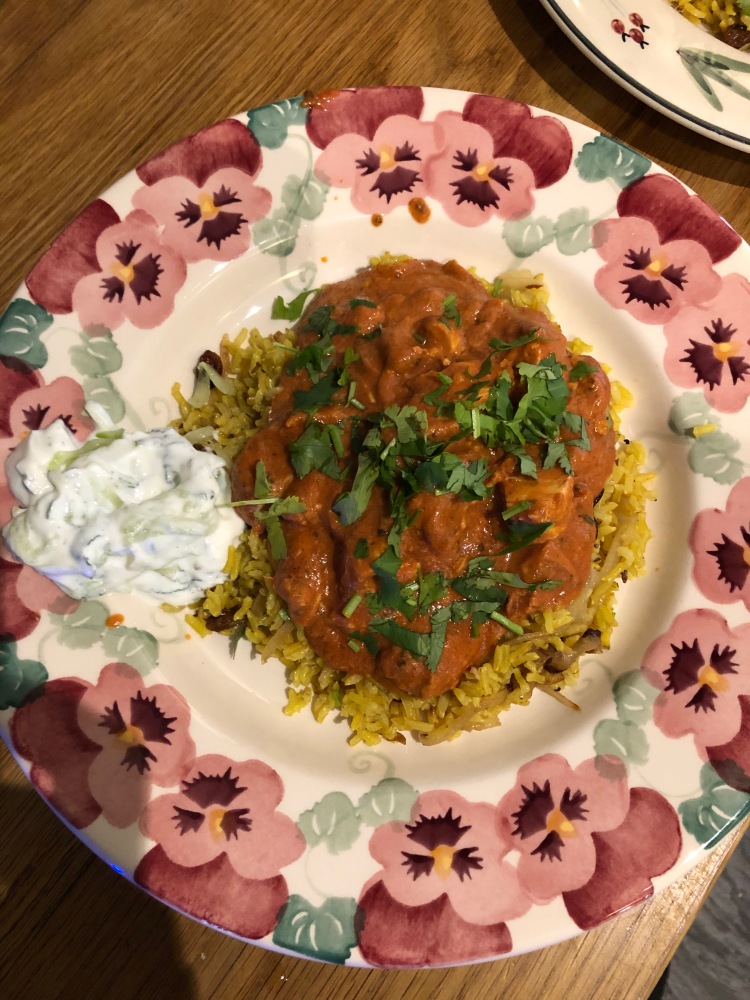
Here’s another recipe picked up from TV (back in 2006). Ainsley Harriott’s quick and low-calorie chicken curry tastes much more complex than it is to make. Serve with mango chutney, raitha and steamed broccoli to make a complete meal. You can keep the rice plain if the embellishments don’t appeal or time is tight.
Curry 500g carton passata 3 tbsp hot curry paste 400g cooked boneless tandoori or tikka chicken breasts, cut into bite-sized pieces 150ml 0% fat Greek yoghurt 0.5 tsp caster sugar salt and freshly ground black pepper
Method Put the rice and turmeric on to cook. Drain when done.
Place the passata in a small pan, stir in the curry paste and heat gently.
Meanwhile, for the rice, heat the oil in a wok and stir-fry the onion for 4 minutes until nicely browned. Add the raisins and almonds and fry until the raisins swell and the almonds take on a little colour. Stir in the cooked rice and heat gently for 3-4 minutes, adding a splash of water if the mixture is a little dry.
Add the chicken and yoghurt to the tomato mixture, bring to the boil and simmer for 2 minutes until warmed through. Stir in the sugar and season to taste.
Season the rice and divide between serving plates. Spoon over the chicken mixture and garnish with coriander, if using.
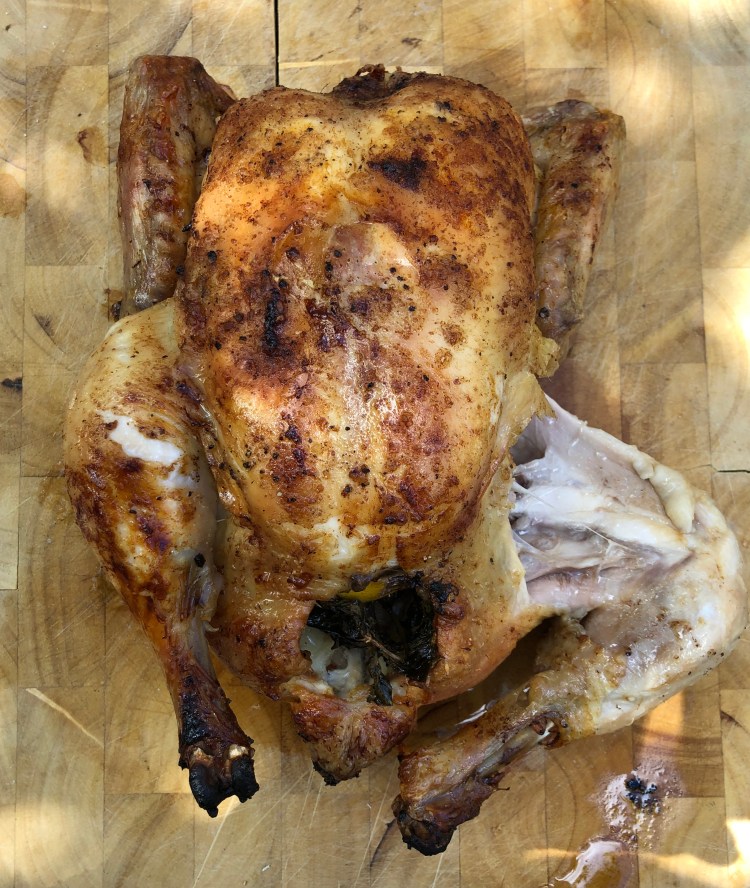
A roast meal takes time and generates a lot of washing up. Pace Sam and Louis, I think it’s worth it. We always make a small stock for the gravy beforehand and then a big stock afterwards, which can serve a range of meals for the following week (risotto, soup, leeks & quinoa to name a few). If you have neither time nor inclination to make a proper stuffing – this one has been passed down from the Scottish side of my family – you can just fill the seasoned chicken cavity with half a lemon and a bunch of herbs (thyme works well). I also like Ottolenghi’s twist: smear the chicken with pomegranate molasses and cover with lots of za’atar. Some of you disagree. All sorts of vegetable sides accompany our roasts: roast potatoes (always), Carluccio’s carrots (usually), Hungarian spinach (often).
Serves 6
Ingredients
1 large chicken (1.8-2kg) 3 carrots, peeled and cut into large chunks 3 sticks celery, cut into 3cm chunks 2 onions Black peppercorns 3 bay leaves 150 ml white wine Salt and pepper Olive oil
For the stuffing: Half an onion, very finely chopped 50g suet 100g porridge oats or oatmeal Salt and pepper Optional: 1 tsp each fresh thyme leaves and lemon zest
Method
Preheat the oven to 200/180 (fan).
To prepare the chicken, pull off the flaps of fat at the entrance to the chicken cavity. Chop off the ends of the drumsticks if your chicken still has those extra joints. Arrange a carrot, a stick of celery and half an onion (in chunks) on the base of a roasting tin or heavy casserole dish: the vegetables create a ‘rack’ for the chicken.
Mix all the stuffing ingredients together and fill the chicken’s cavity, packing the stuffing in well. Close with a skewer (a bamboo one, cut to about 10cm works well). Smear the chicken with olive oil, season all over and then place, breast side down, on top of the vegetables.
Roast in the oven for 1.5 hours. (If your chicken isn’t stuffed it will need less roasting time). Put another carrot, celery, half an onion, 10 peppercorns and a bay leaf with the drumstick ends in a small pan, cover with water, bring to the boil and simmer for about an hour.
After the chicken has had about half an hour, turn it over to lie breast-side up and return to the oven. You might be putting potatoes in to roast at the same time.
When the chicken is cooked (test this by piercing the thigh at its fattest part, to see if the juices run clear), remove from the oven and leave to rest for at least 10 minutes.
To make the gravy, put the baking tray on the hob, on a medium heat, deglaze with some white wine, then add stock and potato water and cook for 5 mins. I prefer this thin ‘jus’ with chicken but if you want something thicker you could add flour before adding the liquids. Check seasoning and adjust as necessary.
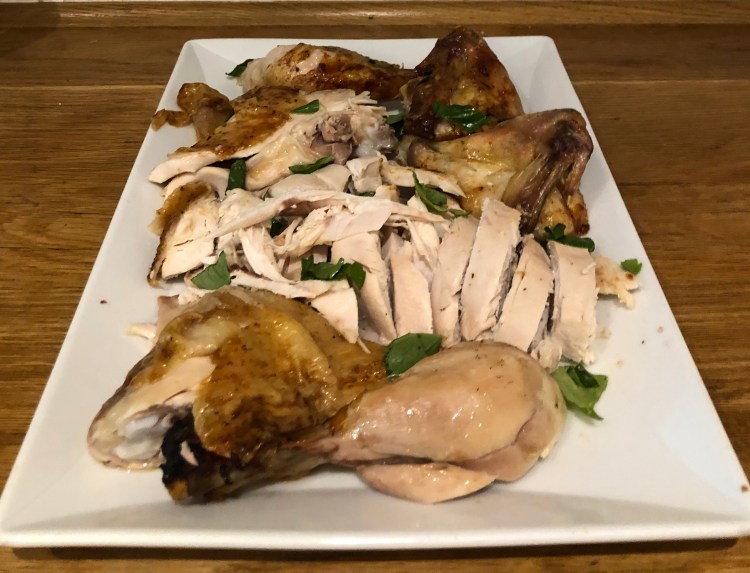
To serve, scoop out the stuffing into a bowl, then carve the chicken. We like Jamie Oliver’s method of carving the breast (remove the whole breast and then slice cross-ways). ‘Common sense tells you that’s going to be mega.’
Chicken stock
There is no excuse not to make a stock afterwards.
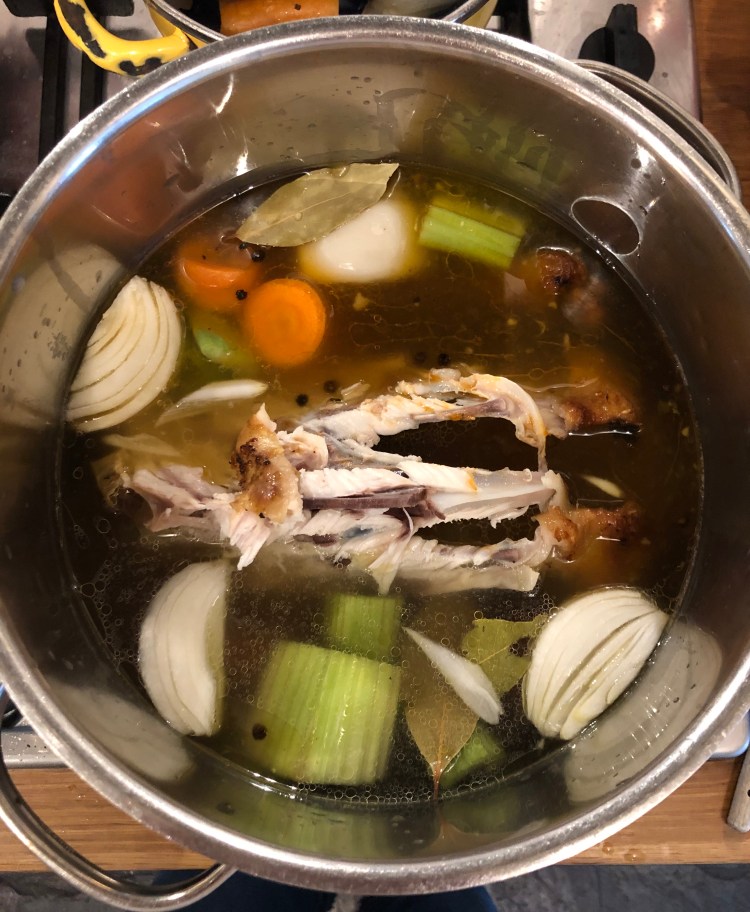
Remove any skin and stuffing from the chicken carcass and gather up the other leftover bones. Place in a large pot along with an onion (quartered), a stick of celery, a carrot, 2 bay leaves and a handful (15 or so) peppercorns. Cover with water, bring to the boil and simmer for 1.5 to 2 hours. Allow to cool (it’s fine to leave overnight), then strain and store in a bowl / tupperware in the fridge or freezer. If there’s too much to accommodate you can boil it down to make a more concentrated stock, which will ‘set’ when chilled.
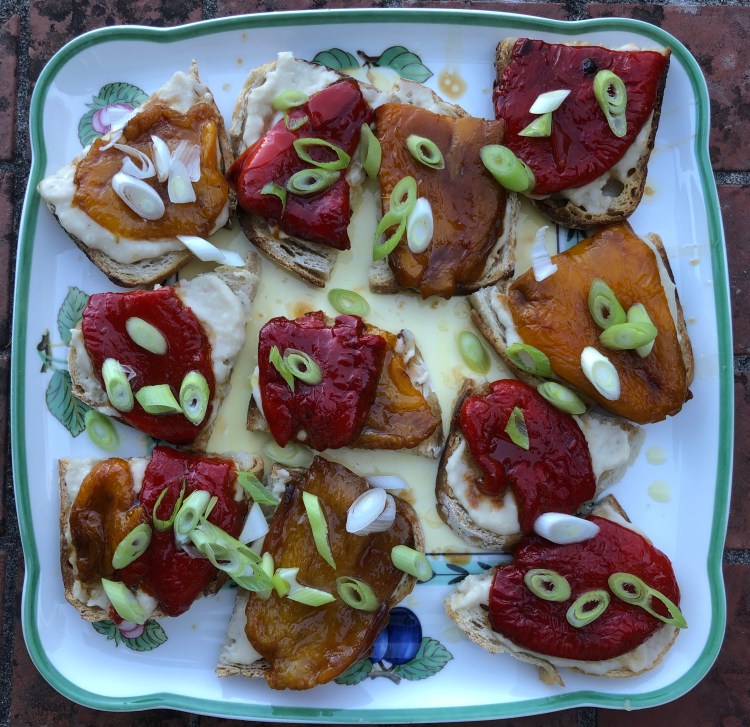
This uses fridge and store cupboard staples that keep well, and it never fails to delight guests. Ottolenghi’s original recipe calls for dried cannellini beans, which require overnight soaking and long cooking, but I’ve found that canned beans work just as well. Apart from the toasting of the bread, all of this can be prepared well in advance.
Serves 6
Ingredients
1 tin or carton cooked cannellini beans, drained 2 red and 2 yellow peppers 120 ml olive oil, plus extra for brushing 2 tbsp balsamic vinegar 2 tbsp water 1 tsp muscovado or soft brown sugar 4 sprigs thyme 5 garlic cloves Juice of 1 lemon 6 large slices sourdough bread 2 spring onions, sliced diagonally Salt and pepper
Method
Heat the oven to 180 (fan).
Cut the peppers into quarters and shave off the white parts and the seeds. Put them in a roasting tray and toss with 2 tablespoons of the oil and a little salt. Roast in the oven for 35 minutes or until soft, then transfer to a bowl and cover it with cling film: this will make them easier to peel.
In a separate bowl, whisk 60ml of the olive oil with the balsamic vinegar, water, sugar, thyme, 2 sliced garlic cloves and a pinch of salt. Once the peppers are cool enough to handle, peel them, add to the marinade with their cooking juices and leave, well immersed, for at least half an hour. I usually leave them overnight in the fridge, where they will keep for up to a week.
Put the beans in a food processor along with a crushed garlic clove, the lemon juice, the remaining olive oil, a teaspoon of salt and a good grinding of black pepper. Process to a smooth paste. Taste and adjust seasoning if necessary. This will also keep for ages in the fridge.
Put the bread slices on a baking tray, brush them with olive oil and sprinkle with a little salt. Bake for 10-12 minutes or until golden brown. While they are still hot, rub the slices with 2 peeled garlic cloves, then leave to cool on a wire rack.
To assemble the bruschettas, halve each slice of toast, then spread with a good amount of the bean purée. Top generously with the marinated peppers and garnish with the spring onions and a drizzle of olive oil.
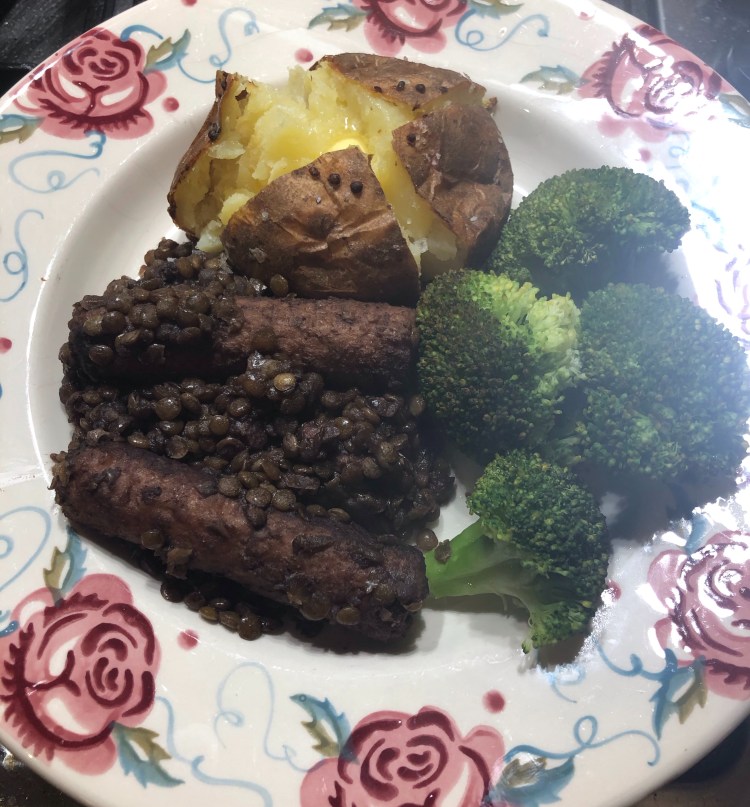
Back in the 90s Dom and I holidayed four times in Provence with Lucy and an assorted company of friends, who all took turns to cook. Some of those meals became legendary (frogs’ legs ‘diving’ into stuffed tomatoes, anyone?). One year we found a Delia recipe in an old magazine: sausages & lentils was pitched as a winter warmer but the Provençal heat did not deter us from trying it. We’ve been making it at home ever since, with baked potatoes and steamed broccoli as our standard accompaniments.
Serves 6
Ingredients 2 tbsp olive oil 1 large onion, finely chopped A small tub of cubed pancetta, lardons or 4 rashers streaky bacon cut into small pieces 12 sausages 300g puy lentils (also called lentilles vertes) 1 tin beef consommé (now hard to come by: 400ml beef stock works too) 150ml red wine 8-10 sprigs thyme 2 bay leaves Black pepper
Accompaniments Six baking potatoes, pricked with a fork A large head of broccoli, cut into big florets Plenty of butter and mustard
Method Heat the oven to 180 (fan) and put the baking potatoes in for 1.5 hours.
In a large oven-proof casserole pan, heat the oil, brown the sausages, then remove. Fry the pancetta in the remaining oil (add more if necessary), then add the chopped onion, turn the heat down and cook for five minutes. Add the lentils, stir, then pour in the consomme / stock and the red wine. Season with pepper, add the bayleaf and thyme and return the sausages to the pan. Bring to a simmer and cook, uncovered, in the oven for about an hour. Check that the lentils don’t get too dry – add water or more wine if necessary. Pancetta is quite salty, so you shouldn’t need to add any more salt.
15 minutes before eating, put the broccoli (salted) on over cold water. Once the water has come to a boil, it will steam the broccoli in 6 minutes.
Serve with baked potatoes, butter and lots of mustard.
Two recipes in one post this week, because they are variations on the same theme. I usually make raitha with thinner yoghurt and grated cucumber, and I don’t add garlic. The cooling effect of the yoghurt here works well to offset the strong spices of an Indian meal. For Tsatsiki (Greek) or Cacik (Turkish), I would dice the cucumber and use garlic, oil and vinegar, giving it a sharper flavour. It is best made with thick Greek yoghurt. A great accompaniment to a Greek meal, tsatsiki is also delicious as a dip with pitta.
1 cucumber Half a large pot of natural yoghurt 3-4 tbsp chopped fresh mint Salt & black pepper
Method
Peel and coarsely grate the cucumber. Place in a sieve and salt liberally. Leave in a sink, or over a bowl, for an hour to disgorge its liquid. Meanwhile, stir the mint and black pepper into the yoghurt. Rinse the cucumber, squeeze out as much liquid as you can and fold into the yoghurt.
Tsatsiki
Serves 4 as a side
Ingredients
0.5 cucumber 200g thick Greek yoghurt 2 tbsp olive oil 1 tsp wine vinegar 1 clove garlic, crushed 3-4 tbsp chopped fresh mint Salt & black pepper
Method
Peel the cucumber and cut into small dice. Place in a sieve and salt liberally. Leave in a sink, or over a bowl, for an hour to disgorge its liquid. Meanwhile, lightly beat the oil, vinegar and garlic with a fork; add the yoghurt and beat until smooth. Rinse the cucumber, squeeze out as much liquid as you can and stir into the yoghurt with the chopped mint and some pepper.
Inside a cookery book (Sophie Grigson’s Food for Friends), given to me by Granny when I was a student, is a collection of dog-eared recipes saved from newspapers and magazines over the years. Frances Bissell’s recipe for individual lemon tarts is among them, originally published in the Saturday Times magazine in November 1997. I made those tarts as one of the pudding options for a New Year’s Eve party we hosted at Gale at the end of the year. (Another memorable element of that party was a treasure hunt featuring a Mexican bar manned by your father in the pool hut.) Since then, I’ve been making this as a single tart, with the quantity of pastry adjusted accordingly. It’s another recipe made much easier by a food processor.
Serves 6, using a 24cm tart tin
Ingredients
Pastry 185g plain flour 20g ground almonds 100g unsalted butter, chilled and cut into cubes 1tsp caster sugar 20g chopped almonds 1 egg yolk Iced water
Lemon filling 3 whole eggs 2 egg yolks (save the whites for making meringues) 175g sugar Juice and finely grated zest of 3 lemons 175g unsalted butter, chilled and cut into cubes
Method
Rub the flour, ground almonds and butter together, by hand or in a food processor. Stir in the sugar and chopped almonds and then the egg and enough iced water to bind the pastry together. Form into a pat on a floured surface (try to avoid handling the pastry too much), cover with cling film and leave to rest in the fridge for at least half an hour, ideally longer.
Grease the tart tin, then roll out the pastry and line the tin. Leave to rest in the fridge again if you have time. Preheat the oven to 160C (fan). Scrunch up some baking parchment, open it out, lay it over the pastry and fill with baking beans. Bake blind for 15 minutes, then remove the parchment and beans and bake for a further 5 minutes, uncovered. (If you want to ensure a really crisp, sealed base, you could brush the pastry with egg white before the second blind bake.) Remove and allow to cool.
To make the filling, stir the eggs, sugar and lemon (zest and juice) in a bowl over simmering water and, when the sugar has dissolved, gradually beat in the butter. Stir for 20 minutes, remove from the heat and allow to cool and thicken. (If any opaque flecks of cooked egg white have appeared, try to fish them out with a teaspoon.)
Pour into the tart case and bake in a preheated oven (160C fan) for 25 minutes, until the filling has just set and slightly risen to a smooth top. Don’t let it brown.
You can dust it with icing sugar before serving, but do this at the last minute so that the sugar doesn’t dissolve and become invisible. Serve with cream and/or a raspberry coulis if you’re after some eye-catching colour.
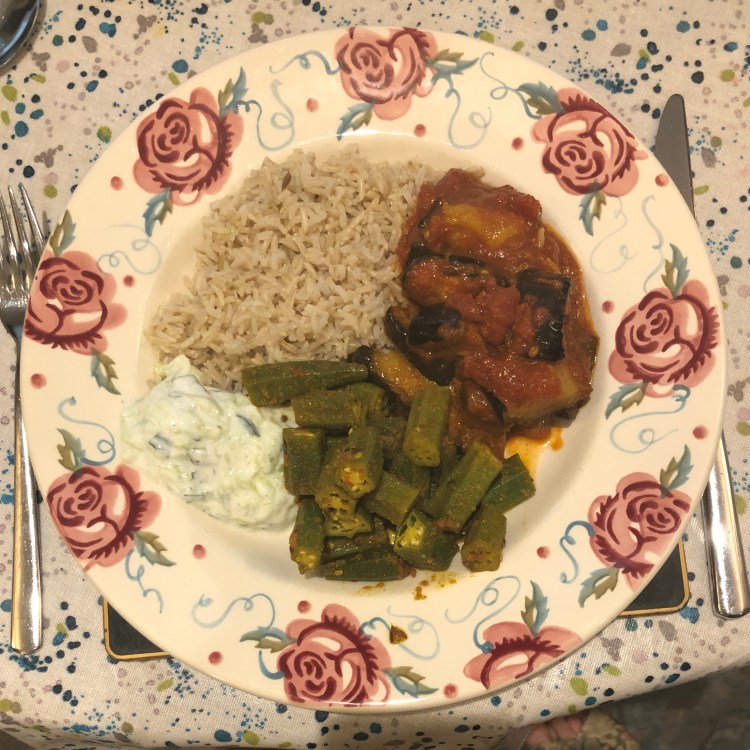
Is this recipe responsible for converting the vegetable-sceptic Zita? It’s another one inspired by Madhur Jaffrey, who gives it the verbose title ‘The Lake Palace Hotel’s Aubergine Cooked in the Pickling Style’. Works well as a meal on its own, with rice, raitha and chutney, or to accompany a more varied Indian meal. It’s also delicious served cold. If you’re wondering whether to buy an electric food processor, this recipe alone, in my opinion, would justify the investment.
Serves 6
Ingredients
2.5 cm cube fresh ginger, peeled and coarsely chopped 6 cloves garlic, peeled 50 ml water 750g aubergines Plenty of vegetable oil 1 tsp fennel seeds 0.5 tsp cumin seeds 1 can chopped tomatoes 1 tbsp ground coriander 0.25 tsp ground turmeric 0.3 tsp cayenne pepper (more, if you like) Salt
Method
Cut the aubergines into slices or wedges that are 2cm thick and about 4-5cm long. Salt liberally and put in a colander to disgorge their liquid for an hour or so. (You can omit this stage if you’re short on time, but it does prevent the aubergines from absorbing loads of oil.)
Put the ginger and garlic into the small container of an electric blender or food processor. Add the water and whizz until fairly smooth.
Pat the aubergines dry, rinse the colander and set it over a plate or bowl. Put 50ml oil in a large frying pan and set over medium-high heat. When hot put in about a third of the aubergine slices. Let them turn a reddish-brown colour, turn over and brown the other sides. Remove the slices and put in the sieve. Repeat with the rest of the aubergines, adding fresh oil to the pan each time. Let the aubergines drain for another hour if you have time. If you don’t, you can get rid of the superfluous oil later.
Heat 3 tbsp oil in the frying pan and, when hot, put in the fennel and cumin seeds. As soon as the fennel seeds turn a few shades darker – takes just a few seconds – put in the tomatoes, the ginger-garlic mixture, coriander, turmeric, cayenne and 1tsp salt. Stir and cook for 5-6 minutes, breaking the tomato pieces up. Turn the heat up slightly and continue to sir and cook until the spice mixture gets thick and paste-like.
Now put in the fried aubergine slices and mix gently. Cook on a medium-low heat for about 5 minutes, stirring very gently. Cover the pan, turn heat to very low and cook another 5-10 minutes if you think it is necessary. Spoon off any pools of oil that have collected.
In 1994, when we were living at Gale, I had a small party for my 25th birthday. Baby Sam (six weeks old) received more presents than I did, but one of the presents I got has stood the test of time. Matthew Faulkner gave me a copy of his friend Hugh Fearnley-Whittingstall’s first cookery book, Cuisine Bon Marché, which became the source of several family favourites, including this braised red cabbage.
Serves 8-10
Ingredients
1 large red cabbage, quartered, cored and shredded (but not too finely) 1 large onion, sliced 30g butter 3-4 tart eating apples, peeled and sliced 2 tbsp red wine vinegar 100ml red wine 2 cloves 2 tsp sugar 0.5 tsp salt
Method
In a large casserole or saucepan, sweat the onions in butter for a few minutes until softened but not brown. Add all the other ingredients and mix gently but thoroughly. Cover and set over a very low heat or in the oven at 150/140 (fan). It will take about 2.5 hours to cook but will come to no harm if you leave it for 3 hours. If you are cooking on the hob, stir occasionally to prevent burning.





 Years of Practice